Travelers already let AI plan the trip. They still won't let it book one.
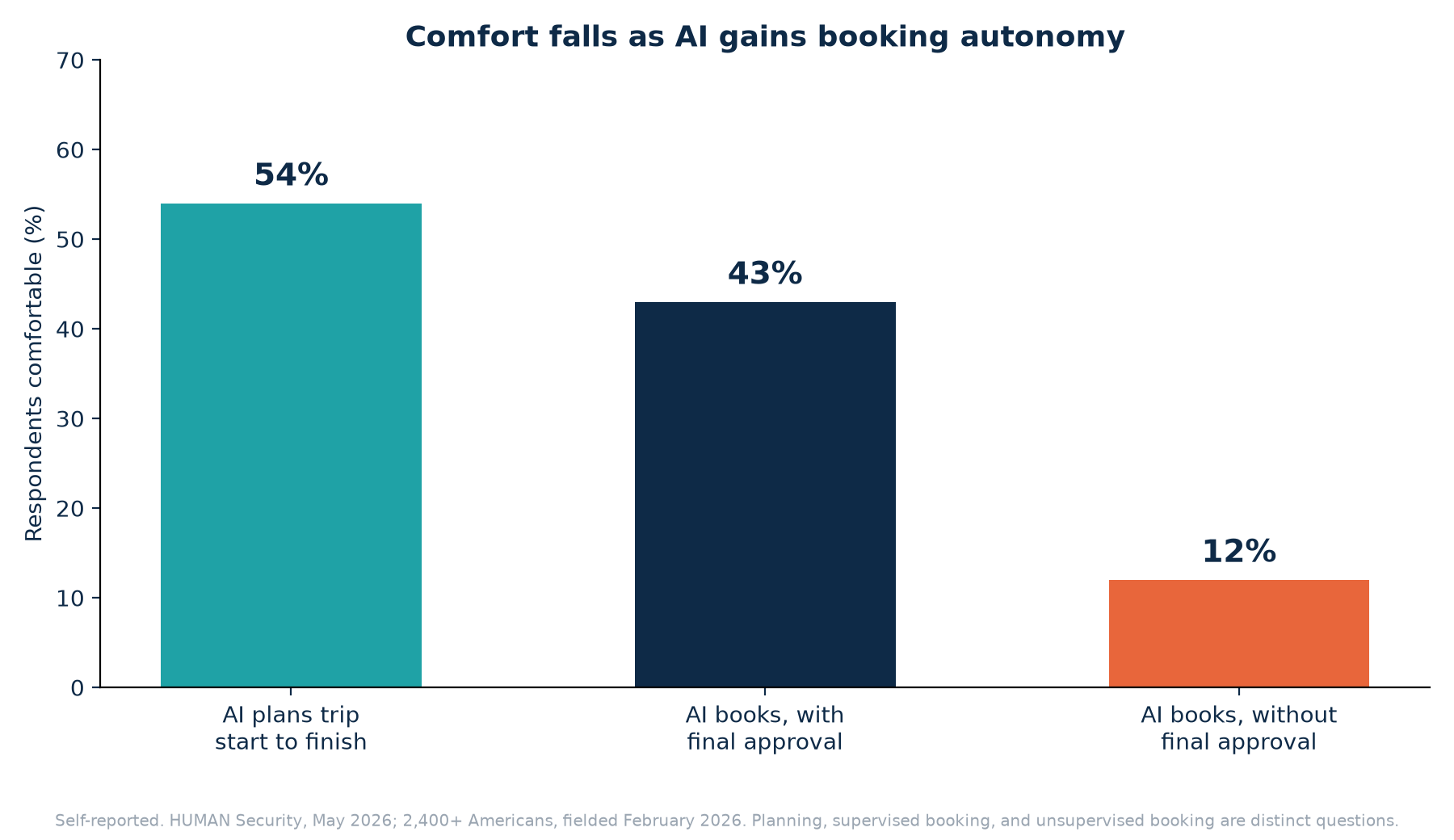
Start with the finding that reframes everything after it — the one this report is most confident in, because the outside world corroborates it. In a February 2026 survey of 2,400+ Americans, 54% were comfortable letting AI plan a vacation from start to finish. Just 12% were comfortable letting it book without their final approval (HUMAN Security, May 2026).
That ~42-point gap between planning a trip and buying one is not a rounding error. It is the commercial case for the human travel advisor, stated in travelers' own words: they will let a machine dream up the itinerary, but they still want a human hand on the decision that costs real money and can go badly wrong. The anxiety pointed at this profession — AI will replace the travel advisor — has the evidence backwards.
This report is about the people standing on the other side of that cliff — and a gap of their own. Read at working depth, the modern advisor already holds what it takes to survive AI: deep expertise, durable client trust, and a real content engine. What's missing is the layer that turns that hidden work into visible, monetizable market presence. From invisible expertise to visible demand is the whole of the opportunity — and the whole of this report.
What we can see — and what we choose not to say
An unusual disclosure belongs up front, because it shapes how much weight the rest of this report can bear: this is the first State of the Travel Advisor written by the AI that advisors themselves use. It was produced through Toby, Voyager Social's advisor-AI system, reflecting on more than two years of work it had already been invited to do alongside advisors — their prompts, drafts, itineraries, and content — and reporting the patterns back in aggregate. This is not a designed study with a recruited sample answering questions about themselves. It is production-proven behavior: what advisors actually did, read retroactively from a live platform.
That means we can see a great deal. We can read the full working context of every advisor in this panel. From it, we could infer who is winning, what they likely earn, and who their clients are. We don't. Every figure here is aggregate and de-identified, and the analysis stops exactly where the evidence stops. Concretely, this report deliberately does not claim, from conversation data:
- Revenue, commissions, or booking conversion — not in this dataset.
- Any individual advisor's success or business outcomes — behavior is not results.
- Client identities or demographics — excluded by design.
- Exclusive destination specialization — a topic "present in an advisor's working context" means it shows up in their work, not that they only (or expertly) sell it.
- Anything about a named individual, agency, or partner — the analysis is aggregate-only.
That restraint is not a limitation of the method. It is the point of it: the same capability that could over-reach is the one disciplined enough not to. This report is the demo; the method is the product — and what the method chooses not to say is part of what it demonstrates.
What this document is
This is a data-driven portrait of an engaged edge of the modern travel-advisor profession — not as the trade press imagines it, and not only as advisors describe themselves in surveys, but as a deliberately selected panel actually works. It is drawn from the private, day-to-day AI workspace where advisors think out loud: their conversations, prompts, drafts, and content, captured on Voyager Social's advisor-AI platform over more than two years.
Its argument, in one line: the travel advisor is not obsolete — the advisor is under-indexed. In this engaged panel, the expertise, client trust, and content practice needed to survive AI disruption are already visible inside daily work. What's missing is the layer that turns that hidden work into visible, repeatable, monetizable market presence. This report measures that gap inside Voyager Social and asks what it may mean for the wider profession.
Every figure is aggregated and de-identified: no individual advisor, agency, client, traveler, or partner organization is identifiable. What is named — deliberately, this edition — is the source: Voyager Social.
Where the data comes from — and why it can say things surveys can't
This report is published by Voyager Social, which operates one of the earliest travel-advisor-specific AI platforms, live since 2023 — before most of the trade had touched a generative tool. That head start is the point: it makes this, to our knowledge, one of the longest-running behavioral records of how travel advisors actually use AI — and perhaps the longest focused specifically on advisor-AI work.
Advisors reach the platform through two paths, and the dataset spans both:
- Independently — advisors who sign up on their own, including many at independent agencies not affiliated with any major consortium.
- Through their networks — advisors who arrive via Voyager Social's relationships with major consortia and host agencies, including Travel Leaders Network, TravelSavers, and Signature Travel Network, among others.
The cohort includes solo entrepreneurs, host-agency independent contractors, and multi-seat agency teams — not one company's staff. It is broad enough to reveal recurring working patterns, but it is not a statistical miniature of the entire profession.
Named organizations are referenced as advisor-affiliation or access-path categories observed in aggregate platform data; mention does not imply endorsement, sponsorship, participation in, or review of this report.
We analyze a deliberately selected cohort of over 500 active, engaged advisors — selected from several thousand across Travel Leaders Network, TravelSavers, Signature Travel Network, and independent agencies — chosen against Voyager Social's proprietary activity-and-engagement criteria (the specific thresholds are not disclosed). This is the difference between a survey and this report: industry AI research is largely self-reported — advisors telling researchers what they think they do. This reads what an engaged panel actually did at working depth. Where its observed behavior can be compared responsibly with external survey findings, we make that comparison; where only Voyager Social can see the measure, we label it as a platform behavioral finding.
What this panel can — and cannot — represent This is a curated behavioral panel, not a representative census of all travel advisors. It deliberately over-indexes people who have engaged deeply enough for working patterns to be visible, and it skews toward the independent, credentialed, host-connected growth edge of the profession. It can show, with high confidence, how this engaged cohort works inside Voyager Social and surface hypotheses worth testing across the wider industry. It cannot by itself estimate profession-wide prevalence, prove causality, or establish business outcomes. External surveys benchmark the macro environment; they do not make the panel representative.
How this report was made
Because the machinery matters, here is the measure level without the trade secret. The findings that follow are built from three lenses applied consistently — declared expertise, framed work, and working context (defined just below) — reduced in every case to aggregate, de-identified measures. The logic of each measure is disclosed so you can argue with it. The extraction-and-classification system that produces those measures at scale — how raw conversation becomes structured signal — remains proprietary. Put plainly: every measure is defined; the engine that computes them is not.
How to read this report (trust levels)
Different findings rest on different evidence. To keep readers from attacking the wrong denominator — or reading a floor as a ceiling — here is exactly what each layer means and how much weight it bears.
| Evidence layer | What it is | How to read it |
|---|---|---|
| External benchmark | A cited public survey, association report, or official statistic | Macro context, not behavioral proof. Question wording, population, and date travel with the number. |
| Registered base | All Voyager Social advisor accounts (size undisclosed) | Adoption/funnel shares only (e.g., "never started"), reported as percentages. Directional denominator, not the analysis population. |
| Engaged cohort (over 500) | The curated working advisors this report analyzes | Highest-confidence behavioral signal. A qualitative deep panel, not a population census — it over-indexes the profession's engaged, independent, credentialed growth edge. |
| Declared expertise | Profile fields the advisor filled in (destinations, about, tenure, credentials) | Self-reported floor. Sparsely completed; a blank field means unstated, not absent. |
| Framed work | Topics named in the advisor's own conversation titles/summaries | Conservative floor. If anything, undercounts — it only catches what the advisor explicitly labeled. |
| Working context | Anything appearing anywhere in the full conversation corpus — the advisor's prompts and the AI's replies to them | Expansive. Read as "this is present in the advisor's working context," not "the advisor specializes in this." It measures demonstrated footprint, not exclusive expertise. |
| Interpretation / hypothesis | A strategic reading of the measured pattern | A proposition to test, not a measured fact. Conditional language is deliberate. |
Wherever a "real vs. stated" gap matters, we report the conservative floor and the expansive read side by side, and label which is which.
A note on method — the measurement triad
Three lenses, applied consistently throughout:
- Declared expertise — what the advisor put on their profile. Self-reported, and a floor.
- Framed work — what the advisor named in their conversation titles. Conservative.
- Working context — what surfaces across the full body of their AI work (prompts + replies). Expansive, and read strictly as presence in their working context.
The story of this report lives in the distance between lens 1 and lens 3: advisors declare little and do enormously. Public benchmarks establish the environment around that behavior; they do not substitute for it or validate every platform-only measure.
What surveys cannot see. External surveys confirm the macro setting: advisor AI use is rising quickly, traveler use has caught up, and human judgment still matters most at the booking decision. Voyager Social's observed data reveals what those surveys cannot see: profile blankness beside real working breadth, chat-versus-feature behavior, content mix, in-workflow distribution abandonment, activation friction, and peer-led growth. No exact public analog was located for those measures. That is not an apology; it is the report's proprietary contribution — stated at the scope actually observed.
TL;DR — six findings worth stealing

- Travelers let AI plan the trip. They won't let it book one. 54% of Americans are comfortable letting AI plan a vacation end to end; just 12% are comfortable letting it book without their final approval (HUMAN Security). That ~42-point cliff is the commercial case for the human advisor — and the most independently corroborated finding here.
- Nearly 8 in 10 engaged advisors never typed what they actually sell. 79% leave the destinations/specialties field blank — yet the conservative framed-work lens shows 81% working across three or more destinations, and their full working context touches ~17 places on average. The raw material for a powerful niche is already in their work; it's just invisible in the profile.
- They plan trips in the chat box ~100× more than in the tool built to plan trips. On Voyager Social, itinerary work happens in open conversation, not in the purpose-built itinerary feature. The text box wins — here, decisively.
- They make ~7 images for every video — and publish almost none of it from where they made it. A visual-first content engine runs out of home offices, but completed publishing inside the platform is effectively zero. Creation is active; the integrated last mile is not.
- When one advisor invites another, it works ~88% of the time. No other measured acquisition loop on the platform converts like a colleague's invitation.
- It was never an adoption problem — it's a never-started problem. 72% of registered Voyager Social accounts have never begun a single AI conversation. Access is not the leak; the first working session is.
Executive summary
The travel advisor did not disappear when the internet learned to book flights. She went independent, went home-based, accumulated hard-won expertise, and — over the last few years — quietly turned into a one-person marketing department powered by AI. (We say she advisedly: 80% of respondents to the 2025 Travel Industry Survey identified as women.)
The AI-disruption anxiety aimed at this profession has the story backwards. Read at working depth, the engaged advisor is not being replaced — she is booming and hiding at the same time, quietly accumulating exactly the assets that survive AI: hard-won expertise, durable client trust, and a prolific content practice. The catch is that almost none of it is visible to the market that would pay for it. In Voyager Social's engaged cohort, that value stays buried in the profile and stalls at the distribution step — a powerful segment producing at scale and under-marketing the very expertise that makes it worth hiring:
- Declared vs. demonstrated. Most engaged advisors leave their specialty field blank (79%) and their "about" empty (78%) — yet their framed work and working context reveal broad, repeatable destination footprints. The evidence needed for strong positioning is sitting in the work, undeclared.
- A seasoned, home-based cohort. Median reported tenure 13 years; ~72% of those who describe their setup work home-based, compared with 67% of respondents in the 2025 Travel Industry Survey. A mature craft, not a gig.
- AI as writer and planner first. The top jobs this cohort hands AI — itineraries, emails/newsletters, destination research, client comms — align directionally with the external survey record, but here they are seen at working depth.
- Cruise is the spine. Cruise is present in the working context of 97% of engaged advisors (conservative framed-work floor 64%). Their most-worked places — Italy, the Caribbean, Alaska — are classic, considered, high-value travel; separately, CLIA found that 63% of surveyed recent cruisers used a travel advisor to book that cruise.
- A content engine with a broken last mile. Advisors run real content operations — but completed social distribution inside the workflow that created the content is essentially nil.
- The activation gap is a platform finding with a category hypothesis. 72% of Voyager Social's registered advisor accounts never started a single AI conversation. That exact magnitude is not an industry estimate; it identifies the platform's largest adoption challenge and a question the wider category should test.
The one-sentence thesis: The modern travel advisor already holds what it takes to survive AI — deep expertise, client trust, a content engine — but the profession has not yet turned that hidden work into visible, monetizable market presence. From invisible expertise to visible demand is the whole opportunity.
The mechanism: The evidence of expertise is already in the work; the next leap is making it visible, repeatable, and distributed.
I. The invisible advisor
The finding: The expertise is real and daily. The profile just doesn't say so.
This is the widest gap in the measurement triad — between declared expertise and working context. Ask the market who a given advisor is and it reads a profile — and the profile is blank. 79% of engaged advisors never filled in the destinations field, and 78% left "about the business" empty. Across Voyager Social's registered base it is starker still (~89% blank). The single most valuable question a traveler can ask — what are you great at? — is answered by an empty box.
That blank is not a confession of being a generalist; it is a declaration gap. Even the conservative framed-work floor — reading only the advisor's own conversation titles and summaries — shows 81% of the cohort working across three or more distinct destinations. Their full working context goes further, touching ~17 places on average. Read that expansive figure precisely: a destination can appear in an advisor's prompt or in the AI's reply, so it measures demonstrated working footprint, not exclusive specialization. A concentration analysis would be needed to turn breadth into a formal niche measure. The floor and the expansive read are shown side by side so you can judge.

What an invisible niche actually looks like (real advisors, de-identified):
- A cruise specialist whose work reveals they don't just sell sailings — they founded a members' travel club that gathers quarterly and cruises together. Profile: blank.
- An advisor whose history shows a rare, high-trust specialty in accessible luxury travel — certified autism-travel expertise, inclusive itineraries. Profile: blank.
- An advisor whose years of work describe a complete practice built around solo women travelers seeking wellness, culture, and community. Profile: blank.
A specialty practiced daily but never advertised is a referral that never happens, a search result that never ranks, a "why you?" that never gets answered. In this panel, the work contains the raw material for positioning that the profile never declares — exactly the gap an AI visibility layer can fix.
Pull-quote: "Nearly 8 in 10 engaged advisors never typed what they actually sell. The raw material for a powerful niche is already in their work; the profile is just the last place it shows up."
II. Not a relic — experienced, independent, and working from home
The finding: Experienced, independent, female, and working from home — the profession's growth edge.
The stereotype of the travel agent as a relic is wrong twice over. Among engaged advisors who report tenure, the median is 13 years; 37% select the maximum the field allows — "30+ years" (which, because the field caps there, undercounts the true veterans). The external record is veteran-skewed too: 56% of respondents to the 2025 Travel Industry Survey were over 55. One nuance inside Voyager Social: veteran tenure predicts whether an advisor engages, yet among the engaged, newer advisors use the conversation layer more intensely. A mature craft, refreshed at the entry point.
The demographic backdrop makes the "growth edge" concrete. The traditional employee travel-agent workforce is ~7% smaller than a decade ago (Data USA, 2024), while the Bureau of Labor Statistics counts 65,700 employee jobs in 2024 and projects modest 2% growth through 2034. Those employee-only measures do not count the full independent-contractor channel. The defensible conclusion is not a single profession-wide headcount; it is a changing shape. The engaged Voyager Social cohort sits on its independent, home-based edge: ~72% of those reporting setup work from home, compared with 67% in the 2025 Travel Industry Survey.
Most don't go it entirely alone. 57% of engaged advisors on Voyager Social attach to a host agency or consortium. The affiliations advisors most often name — Signature Travel Network, Travel Leaders Network, Virtuoso, and a long tail of hosts — reflect the panel's network-connected composition. An engaged advisor is also twice as likely to hold a credential (IATA, CLIA, ARC) as a typical Voyager Social account (34% vs 17%). Within this platform, credentials and host ties are the cleanest observable markers of activation: credentialed advisors are ~2.4×, and host-affiliated advisors ~2.7×, as likely to become power users. These are platform associations, not causal industry rates.
Pull-quote: "The median engaged advisor has 13 years in the business and runs it from home. This is a mature craft, not a gig."
III. The text box beat the tool built for the job
The finding: They use AI as a writer and a trip-planner first, a marketer second — and they do it in open conversation, not in features.
Classifying conversations by purpose, a clear hierarchy appears — by share of engaged advisors who did each at least once:
| What they asked AI for | Share of engaged advisors |
|---|---|
| Build an itinerary / trip plan | 59% |
| Write an email or newsletter | 57% |
| Destination knowledge / recommendations | 50% |
| Client communications (welcome, follow-up, thanks) | 42% |
| Proposals, quotes, pricing | 39% |
| Social content (captions, hashtags, IG/FB) | 35% |
| Marketing (promos, campaigns, flyers) | 34% |
| Video / scripts | 32% |
| Website / SEO | 26% |
| Blogs / articles | 15% |
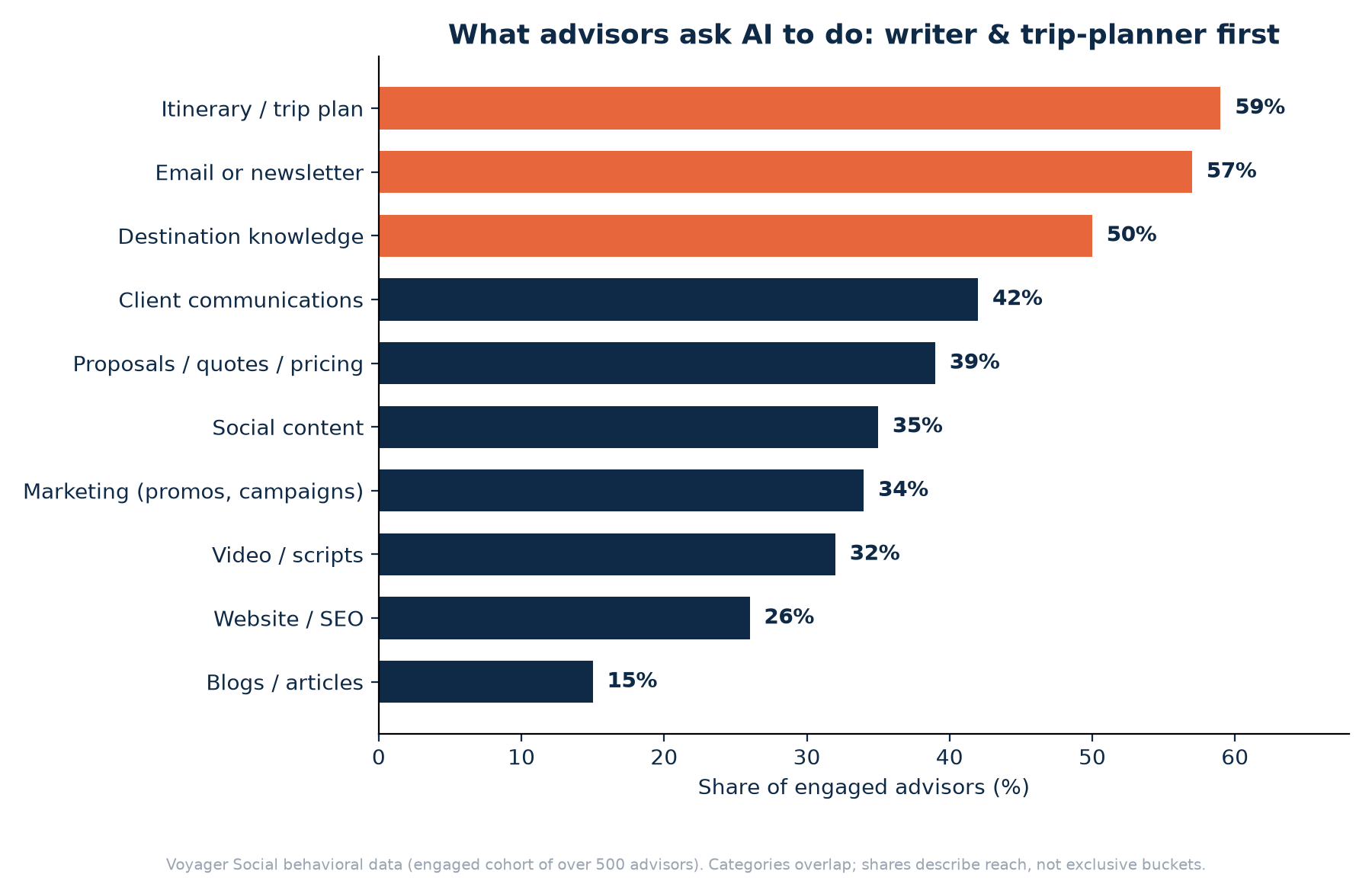
Two things stand out. First, writing is the killer app: email-and-newsletter work (57%) runs neck-and-neck with itineraries (59%) as the two biggest jobs. Advisors are drowning in client correspondence, and AI is the life raft. External surveys also place marketing/website content and itinerary creation among advisors' leading AI interests and uses — but here the hierarchy is measured in behavior, not recall.
Second, a loud, platform-specific product signal: advisors build itineraries in open chat ~100× more often than in Voyager Social's purpose-built itinerary tool, which has been touched by only a handful of advisors. Feature exposure, placement, and maturity may contribute to that ratio; the measured conclusion is still striking: on this platform today, itinerary work happens in the conversation. The tools belong behind that conversation, not in a competing workflow beside it.
Pull-quote: "Advisors built itineraries in open conversation ~100× more often than in the tool built for it. Don't fight the text box — put the tools behind it."
IV. From typing to directing: how the work is maturing (2023 → 2026)
The observed pattern: Across the platform archive, advisor-AI work increasingly looks less like asking for sentences and more like giving direction.
Because Voyager Social has run since 2023, its archive can show how the language of advisor-AI work differs across platform eras. The pattern is vivid, but this analysis is directional rather than a controlled same-advisor panel: product changes, new cohorts arriving with stronger AI skills, and composition effects may explain part of the shift.
- Early-era examples — tasks. "Write a Facebook post about Alaska." "Clean up this email." Single artifacts, one at a time — AI as a better typewriter.
- Middle-era examples — patterns. Welcome emails re-asked, caption formats re-built, reusable prompts beginning to appear — signs consistent with systems thinking.
- 2026 examples — direction. "Create a three-month editorial calendar, a different theme each week." "Act as my marketing manager — here's my brand voice." Multi-step campaigns and explicit voice direction now appear in the archive — work that treats AI more like a junior team member than a typewriter.
The outside world's numbers establish the adoption backdrop: Travel Weekly's survey found advisor use of AI platforms or tools rising from 41% in 2024 to 59% in 2025, while U.S. small-business genAI adoption rose 23% → 40% → 58% across 2023–2025. Those are self-reported, non-equivalent survey measures. Voyager Social adds a different view: examples of work becoming more ambitious inside a multi-year archive. A future within-advisor progression analysis should test how much of that pattern is true individual deepening versus cohort and product change.

Pull-quote: "The archive is moving from paragraphs toward direction: brand voices, editorial calendars, multi-step campaigns. The pattern is visible now; the within-advisor proof is the next analysis."
V. Forget the hot-list — advisors work Italy, cruises, and Alaska
The finding: The working advisor's world is anchored by classics and cruises — not the magazine hot-list.
Travel media spends 2026 touting exotic emerging destinations. The advisors' own work tells a grounded story. Ranked by the share of engaged advisors discussing each place (framed-work floor, the conservative lens):
| Rank | Destination | Share | Rank | Destination | Share |
|---|---|---|---|---|---|
| 1 | Italy | 34% | 8 | Greece | 18% |
| 2 | Caribbean | 33% | 9 | Japan | 17% |
| 3 | Alaska | 30% | 10 | Spain | 17% |
| 4 | Europe (broad) | 25% | 11 | Hawaii / Mexico | 15% |
| 5 | Theme parks (incl. Disney) | 20% | 13 | Portugal | 14% |
| 6 | France | 19% | 14 | Canada | 13% |
| 7 | Ireland | 18% | 15 | Africa / safari | 12% |
Italy leads. The Caribbean and Alaska — both cruise country — round out the top three, which is no accident: cruise is the connective tissue of this engaged advisor panel. In the fuller working-context read, cruise is present for 97% of engaged advisors, resorts/all-inclusives 94%, river cruise 76% — well above the conservative framed-work floors (64% / 42% / 26%). Other recurring work themes follow (adventure 36%, luxury 32%, multigen/family 25%, groups 24%, honeymoons/destination weddings ~20%), plus a real expedition tail (Antarctica, the Galápagos, safari).
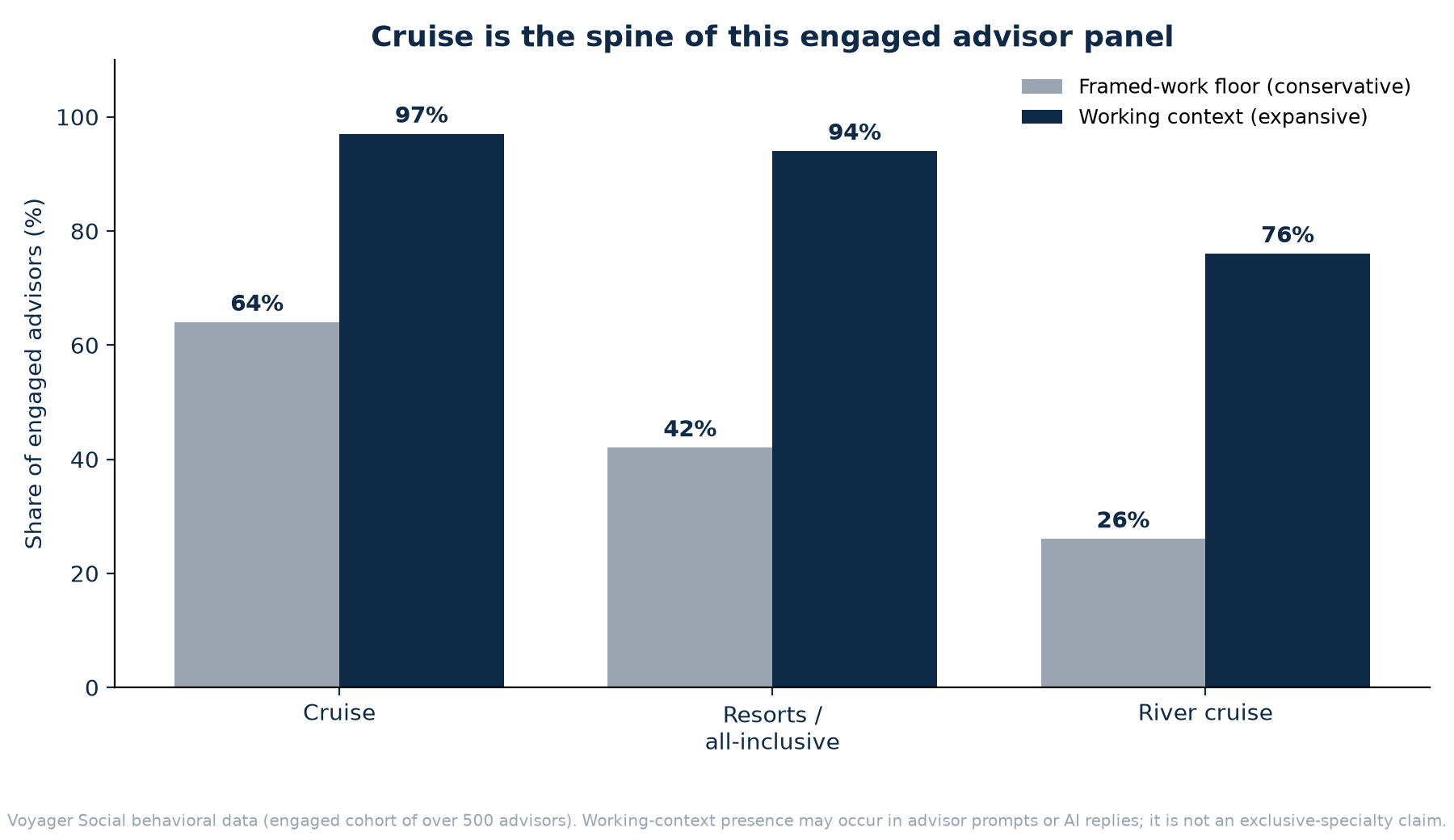
The pinned external measure explains why this matters commercially. In CLIA's December 2025 survey, 63% of surveyed people who had cruised in the prior 12 months said they used a travel advisor to book that cruise (n=1,884), within a reported 60–66% range since 2022. That is a booking-incidence question — distinct from whether an advisor influenced the decision and from claims about total channel share. Separately, global ocean-going cruise volume reached 37.2 million passengers in 2025. The advisor panel's map shows where that commercially important category appears inside daily AI-assisted work.
Pull-quote: "Cruise appears in the working context of 97% of engaged advisors — while 63% of surveyed recent cruisers said they used an advisor to book."
VI. The one-person media company
The finding: Inside Voyager Social, the modern advisor produces content at the rhythm of a small marketing operation.
Give an advisor an AI studio and they don't write one email — they build a library. The shape of platform-wide creative output:
- Advisors generate ~7× as many images as videos, and nearly 4× as many images as saved design templates — a decisively visual-first content operation.
- Creation is broad enough to produce a genuine reusable library, not a handful of one-off experiments.
- Yet ~35% of the engaged cohort saves no reusable image, template, prompt, or document despite working in conversation — a capture gap inside an otherwise prolific workflow.
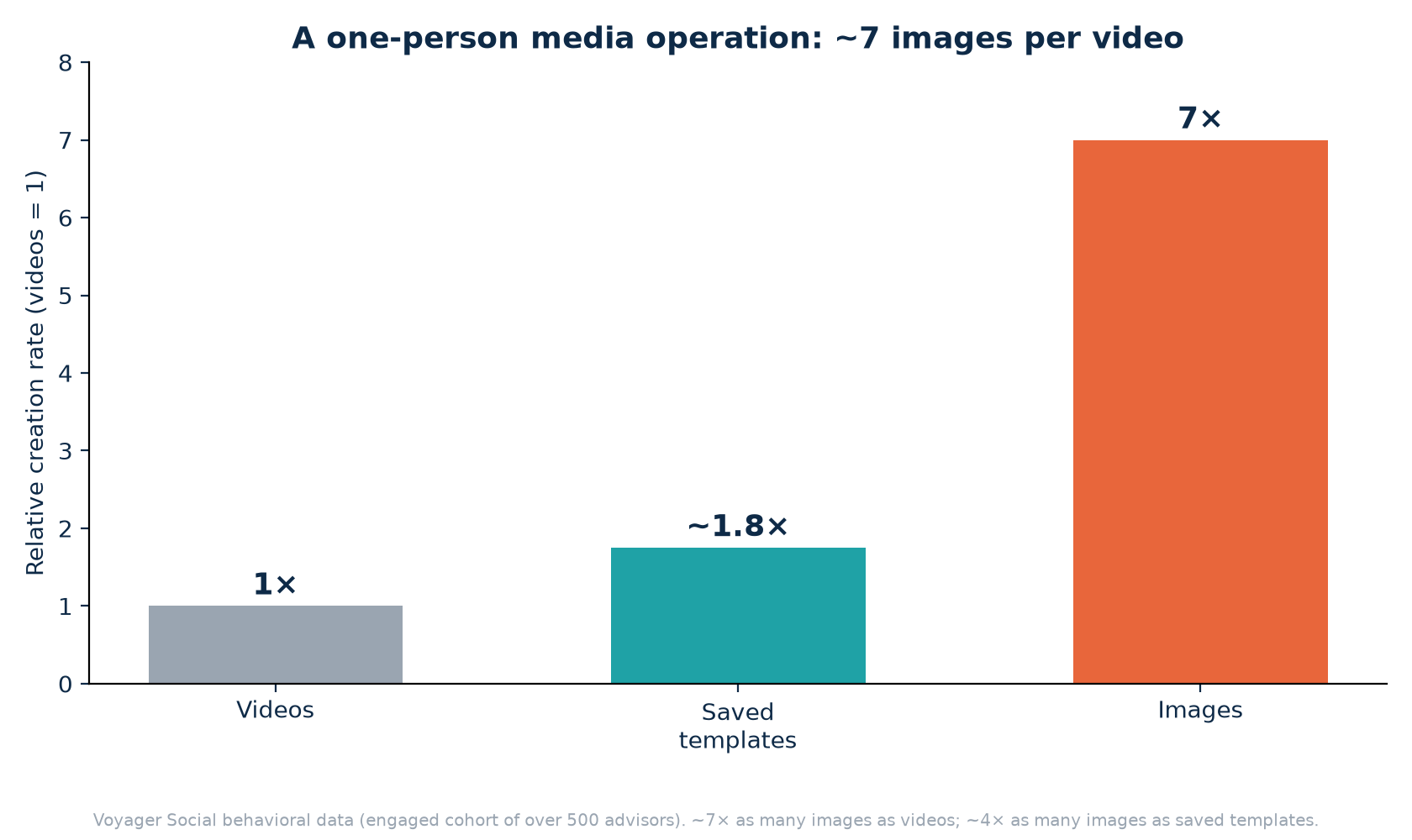
No public advisor benchmark located in this research pass measures image-versus-video creation or reusable-asset cadence inside an AI workspace. That makes the pattern a proprietary behavioral contribution, not a weak one: it is directly observed on Voyager Social and stated only for the population and workflow measured.
That habit gap tempers the story: advisors generate real value in conversation but do not always convert it into a reusable asset — a workflow gap, not a skill gap. The studio is running; roughly one in three just never hits save.
Pull-quote: "The engaged cohort runs visual-first content studios out of home offices — seven images for every video — yet roughly one in three saves nothing reusable."
VII. Creation is active. The last mile isn't.
The finding: Inside the AI workflow that creates the content, the last-mile distribution step goes unused.
Here is the sharpest contradiction in the data — and the one most easily misread, so read it precisely. Advisors produce marketing content at scale, and 35% ask AI for social captions and posts. Yet the "publish to social" step inside the platform sits idle:
- effectively zero posts published through the platform,
- essentially no pre-built post packs used,
- a near-zero share have connected a social account or listed a handle.
What this does not mean: it does not mean advisors don't post to social media. In fact, Travel Weekly's 2024 survey found 73% used organic social media to attract clients and 61% used it to retain them. The Voyager Social finding is narrower and more actionable: the distribution step is not being completed inside the AI workflow that produced the content. Content may be copied and published elsewhere; this platform does not observe that final destination. Inside the measured workflow, creation is active and the integrated last mile is abandoned.
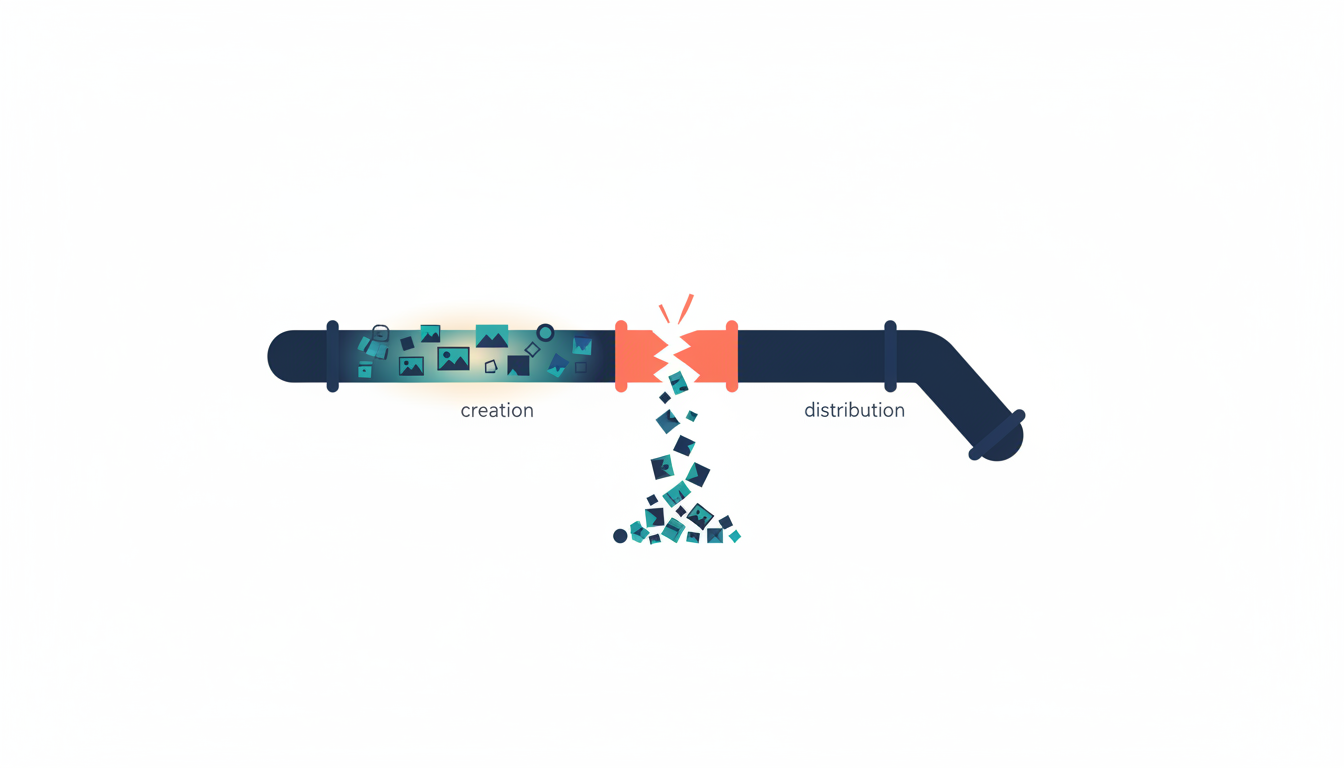
Pull-quote: "On Voyager Social, creation is active. What's unfinished is distributing from inside the same workflow — a precise, observable last-mile gap."
VIII. It was never an adoption problem. It's a never-started problem.
The finding: Most registered Voyager Social accounts never start. Whether the wider category shares that activation pattern is a hypothesis, not a measured fact.
Across Voyager Social's registered base, 39% logged in during 2026 and just 28% have ever started a single AI conversation — so 72% of registered accounts have never had one. The engaged cohort proves the product can support deep working use; the measured leak is getting an account into its first conversations. Adoption, in the survey sense, has already happened around these advisors — the missing step is the first working session.

External surveys provide context, not validation of that 72%:
- Travel Weekly found 59% of advisor respondents had used AI platforms or tools in 2025, up from 41% in 2024; just 7% were unaware of them. "Used" is not the same as "activated deeply," and the survey itself is unweighted and nonrepresentative.
- U.S. small businesses self-reported 58% genAI use in 2025, up from 40% in 2024 and 23% in 2023.
- Traveler use closed the gap unusually quickly: Phocuswright found 56% of qualified U.S. leisure travelers used AI for planning, booking, or in-destination assistance for at least one trip in the prior 12 months, up from 43% in late 2025 and 33% in early 2025.
And the trust ladder from the top of this report is the reason activation is worth fighting for: usage, planning comfort, and autonomous-booking comfort are different measures. HUMAN Security's February 2026 survey keeps the question ladder inside one source: 54% were comfortable using AI to plan a vacation from start to finish, 43% were comfortable with AI booking if they gave final approval before payment, and only 12% were comfortable with booking without final approval. Travelers want the machine and the human — which is exactly the seat an activated advisor occupies.
The category hypothesis is sharp even though the denominators are different: access and awareness do not guarantee working activation. Voyager Social can measure that activation gap directly inside its own base; the wider industry should test it rather than inherit the platform's 72%.
Pull-quote: "On Voyager Social, 72% of registered accounts never started an AI conversation. It was never an adoption problem — it's a never-started one."
IX. Advisors recruit advisors — the loop that converts
The finding: On Voyager Social, peer invitation is the strongest measured acquisition loop.
While the in-workflow social-publishing step lies dormant, one loop quietly outperforms everything: agencies keep about 70% of their purchased seats filled, and when team leads invite colleagues, 88% of those invitations become real accounts. Nothing else measured on the platform converts like that.
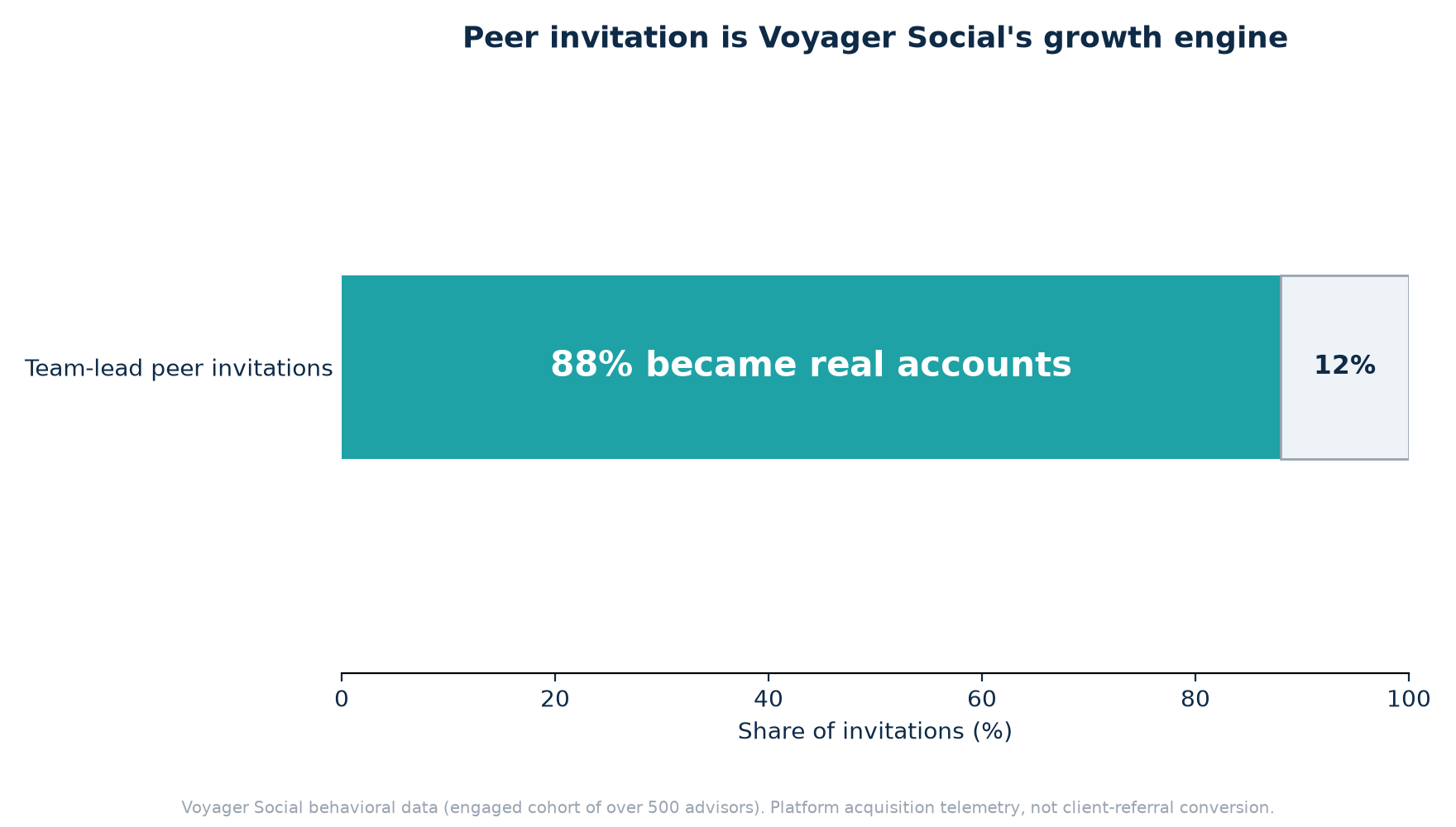
The interpretation is cultural: travel advisors appear to trust other travel advisors. Referral is a familiar growth pattern in this trust-based profession; Voyager Social contributes the observed platform result. Growth here is a peer network, not merely an ad campaign, and any platform strategy that ignores the invitation loop ignores its own best-converting path.
Pull-quote: "The best-performing growth channel isn't social or search — it's a colleague's invitation, which converts at 88%."
What this means — by seat at the table
For advisors. Your moat is the expertise your work demonstrates and your profile may never name. The highest-return hour you can spend is turning the repeated patterns in your calendar into positioning a stranger can understand. You're also, whether you meant to or not, a media company. Traveler AI use has already reached 56% among qualified U.S. leisure travelers, while only 12% of Americans surveyed by HUMAN Security were comfortable letting AI book without final approval. The judgment seat is yours to keep — if you're visible enough to be found.
For suppliers and cruise lines. The advisor channel matters to your highest-value product: 63% of surveyed recent cruisers said they used an advisor to book that cruise, and cruise is present in the working context of 97% of engaged Voyager Social advisors. Their pitches are increasingly drafted in AI conversations. The brands that show up inside that workflow — with usable content and AI-ready assets — are better positioned to enter the itinerary.
For consortia and host agencies. Affiliation is the strongest activation signal in the data (host-affiliated advisors are ~2.7× as likely to become power users), and the 88% peer-invite conversion makes every engaged team lead a distribution channel. AI enablement is now a member-retention benefit — the networks that operationalize it compound their advantage.
For tourism boards and DMOs. This may become a forward demand-formation signal: what advisors discuss while planning could lead arrivals data. The current report is a static footprint, not yet a validated leading index; a destination time series is the next test. Italy, the Caribbean, and Alaska dominate the panel's framed work; Japan is the breakout. Marketing aimed at advisors' AI workflows reaches people packaging trips at the moment they package them.
For platforms and toolmakers. Three imperatives from Voyager Social's measured workflow: (1) sell the integrated last mile — creation is active, in-workflow distribution is not; (2) meet advisors in the conversation — itinerary work currently favors open chat by ~100:1 on this platform; (3) fix activation — 72% of registered Voyager Social accounts never started a conversation. These are strong product signals and category hypotheses, not universal rates.
Benchmark yourself (five questions for working advisors)
Five questions. Answer them honestly — most working advisors flunk at least three.
- Is your destinations/specialties field filled in? (79% of engaged advisors: no.)
- Could a stranger name your positioning from your public profile — or only from your calendar? (Voyager Social observes a wide gap between blank profiles and rich working footprints.)
- Have you had your first several AI working sessions? (On Voyager Social, the measured leak is getting registered accounts to begin.)
- Did anything you created this month actually get published? (Measured answer: almost never, from inside the workflow.)
- When did you last save a prompt or template you'll reuse? (~35% of the engaged cohort saves nothing reusable.)
If any answer stings, that's the point — each is fixable in an afternoon, and the advisors who fix them convert practice into presence.
The bottom line
The state of the travel advisor in 2026 is a paradox worth sitting with. External surveys show a veteran-skewed, increasingly AI-using profession. Inside Voyager Social, an engaged panel turns that environment into visible working behavior: advisors with decades of taste running content operations from home offices, planning Italy and Alaska and Japan, writing, researching, and building in conversation. And here is that same panel, all but invisible in the places the market can see: specialty fields blank, content not distributed from the workflow that created it, most registered accounts never opening the door.
This is not a story of obsolescence. Traveler AI use has closed the adoption gap unusually quickly and now sits near the latest advisor survey level — but comfort drops off a cliff as AI gains booking autonomy: only 12% of Americans in HUMAN Security's survey were comfortable with booking without final approval. The advisor's answer is not to compete with the algorithm but to be found when judgment matters. The evidence of expertise is already in the work; the next leap is making it visible, repeatable, and distributed. From invisible expertise to visible demand — that is the whole of the opportunity, and it is nearer than the anxiety suggests.
Editorial policy & research independence
- Source, named: this analysis is drawn from Voyager Social's live advisor-AI platform. We name the source because transparency, not anonymity, is what lets you weigh the findings.
- Interest, disclosed: Voyager Social has a commercial interest in advisor AI adoption. We disclose our method (below, and the triad above) precisely because of that interest — the numbers are defined so they can be argued with.
- Method, proprietary by design: how we extract and classify these signals at scale is Voyager Social's proprietary capability — the product being demonstrated — not a detail withheld to obscure the data.
- People, protected: every figure is aggregate. No individual advisor, agency, employee, client, traveler, or partner organization is identifiable, and no client/brand logos appear.
- Named organizations, not endorsers: named organizations are referenced as advisor-affiliation or access-path categories observed in aggregate platform data; mention does not imply endorsement, sponsorship, participation in, or review of this report.
What we did NOT infer
This report deliberately does not claim, from conversation data:
- Revenue, commissions, or booking conversion — not in this dataset.
- Individual advisor success or business outcomes — behavior ≠ results.
- Client identities or demographics — excluded by design.
- Exclusive destination specialization — a destination "present in the working context" means it shows up in the advisor's work, not that they only (or expertly) sell it.
- Anything about a named individual, agency, or partner — the analysis is aggregate-only.
The treatment: from diagnosis to an AI visibility engine
If the report shows a visibility gap, the next question is operational: how does an individual advisor close it? Not with "more AI." Advisors don't need another blank prompt box or content generator. They need an AI visibility engine — a layer that reads the work they're already doing, identifies evidence of expertise hiding inside it, and turns that evidence into market-facing presence. For advisors, the cohort-level intelligence in this report becomes useful only when it becomes personal. At Voyager Social, that personal layer is the same system that produced this report: Toby.

Toby is an AI visibility engine for advisors — part profile healer, part marketing strategist, part memory of the work they've already done. It has four jobs the findings define precisely:
- Profile healing — read the working context and fill blank specialty/about/destination fields in the advisor's own voice (§I). The evidence already exists; the engine turns it into draft positioning.
- A content-to-distribution bridge — close the last mile §VII exposes: take what advisors already create and complete the publish step from inside the workflow.
- Conversation-native workflow — put the tools behind the chat, because §III observes itinerary work favoring conversation ~100:1 in the current Voyager Social workflow.
- A referral / team-activation loop — lean on the 88% peer-invite conversion (§IX) to address the platform's 72% never-start gap through its strongest measured acquisition path.
Under the hood, Toby reads what an advisor already does and turns it into what the market can see: it surfaces repeated themes, quotes the advisor's own words back as proof, drafts the profile they never finished, and hands back the next best move. The report you just read is aggregate; Toby's output is personal, per-advisor, and grounded in each advisor's own work. The same behavioral-intelligence capability that produced these findings is what powers it.
Advisor-AI conversations are becoming a hidden operating layer of the travel trade. Understanding that layer creates a path to measure advisor intent, content gaps, supplier presence, activation friction, and candidate demand-formation signals before they appear in conventional reporting. Some of those enterprise analyses remain to be built; the behavioral substrate is already here. For partners and suppliers, that is the second frame of this capability: behavioral intelligence over the advisor channel.
If this class of intelligence is useful to you, here's the question we can answer for each of you:
- Suppliers & brands — where does your brand actually appear (and not) inside advisors' AI-assisted selling, and how do you get into the itinerary?
- Cruise lines — how do advisors frame cruise value in AI-assisted proposals, and where are the openings?
- Tourism boards & DMOs — what does forward demand for your destination look like before it shows up in arrivals data?
- Host agencies & consortia — where are your members' activation gaps, and what prompt-library and enablement moves close them fastest?
Either way, the throughline is the same: advisors already practice the expertise; Voyager helps convert that practice into presence.
This report is the demo; the method is the product. Inquiries: press@advisortravel.report.
Methodology & limitations
- Scope and denominator. Aggregate analysis of Voyager Social's advisor-AI platform: a deliberately selected engaged cohort of over 500 active advisors, chosen against proprietary activity-and-engagement criteria (thresholds not disclosed). It is a behavioral deep panel, not a representative census; it likely over-indexes engaged, independent, credentialed, host-connected advisors. Findings describe this panel unless explicitly labeled as an external benchmark. The only precise headcount disclosed is "over 500." The surrounding pool is described only approximately ("several thousand" across the named networks and independent agencies); no exact base/pool size, per-network counts, funnel/asset totals, or economics are disclosed. No production data was modified in producing this report.
- The measurement triad. Findings are labeled by evidence layer — declared expertise (profile fields; self-reported floor), framed work (conversation titles; conservative floor), and working context (full corpus, prompts + AI replies; expansive, read as presence in working context, not exclusive specialization). "Real vs. stated" gaps show the floor and the expansive read side by side (e.g., three-or-more destinations: 81% framed-work floor vs the fuller working-context read; cruise 64% floor vs 97% working-context).
- Proprietary extraction. The extraction and classification system that turns raw conversations into these structured measures is Voyager Social's proprietary capability and is intentionally not detailed. Every measure is defined; the system that produces them at scale is proprietary.
- Industry benchmarks. Public sources (see Sources) establish macro context where populations and questions are clear. They do not make the panel representative, and lack of an external analog does not weaken a directly observed Voyager Social finding. Survey and behavioral measures are not treated as interchangeable.
- Self-reported fields. Tenure, credentials, workplace, and destinations are optional and sparsely completed; tenure percentages are computed among advisors who report a value, and the field caps at "30+," so veteran shares are floors.
- Intent classification groups conversations by topic; categories overlap, so shares describe reach, not exclusive buckets.
- Time. Voyager Social has operated since 2023; the behavioral archive spans more than two years. Content-production figures are lifetime, expressed as ratios and per-advisor averages. The 2023→2026 sophistication pattern is directional at platform level; a controlled within-advisor progression analysis has not yet been completed.
- Not measured / out of scope. Booking value, commissions, revenue; end-client identities and itineraries; any advisor-level detail — see What we did NOT infer.
Validation & error controls (consolidated)
Risk Control applied throughout this report Sparse optional profiles read as absence A blank field is treated as unstated, not absent AI replies inflating destination/theme presence Working context is labeled as its own expansive layer — read as presence in working context, never "specialization" Overlapping intent categories read as exclusive Categories overlap; shares describe reach, not exclusive buckets Platform findings read as industry rates Platform-specific measures are labeled as such — never as industry prevalence External surveys read as validation of the panel External surveys are macro context only; they do not make the panel representative Individual identifiability Illustrative examples are de-identified; every figure is aggregate Breadth mistaken for niche Destination breadth ≠ specialization; a concentration analysis is noted as future validation
Sources
- Travel Weekly / Phocuswright — 2025 Travel Industry Survey (n=1,562 advisor respondents; 80% women, 56% over 55, 67% home-based ICs/agencies; recruited from publisher audiences and consortium/host members; explicitly unweighted and not representative of all U.S. agencies)
- Travel Weekly — 2025: A Year in Review (59% used AI platforms or tools in 2025, up from 41% in 2024) and AI-curious advisors: Check out agentic AI (7% unaware in 2025)
- Travel Weekly / Phocuswright — Technology, marketing and communications (2024) (73% used organic social media to attract clients; 61% used it to retain clients)
- Phocuswright — The fastest shift in travel behavior just became the default (Mar. 2026) (56% of qualified U.S. leisure travelers used AI for at least one trip in the prior 12 months, up from 43% in 2H25 and 33% in 1H25; n=1,570, fielded Feb. 8–17, 2026)
- HUMAN Security — Americans' Use of AI for Summer Travel (May 2026) (54% comfortable with AI planning a vacation end to end; 43% with AI booking subject to final approval; 12% with booking without final approval; 2,400+ Americans, fielded Feb. 2026)
- CLIA — 2026 State of the Cruise Industry Presentation (63% of surveyed recent cruisers used a travel advisor to book that cruise; exact booking question, Dec. 2025, n=1,884; 60–66% range since 2022) and 2026 report page (37.2 million global ocean-going cruise passengers in 2025)
- U.S. Chamber of Commerce — Empowering Small Business (2025) (58% self-identified genAI use; 23%→40%→58% across 2023–2025; n=3,870, fielded June 2025)
- U.S. Bureau of Labor Statistics — Occupational Outlook Handbook: Travel Agents (65,700 employee jobs in 2024; 2% projected growth to 2034) and Data USA — Travel Agents workforce profile (2024) (workforce ~7% smaller than in 2014)
- Partner/arrival-channel names verified against their official sites: Travel Leaders Network, TravelSavers, Signature Travel Network; "independent agencies" denotes advisors not affiliated with a major consortium.